
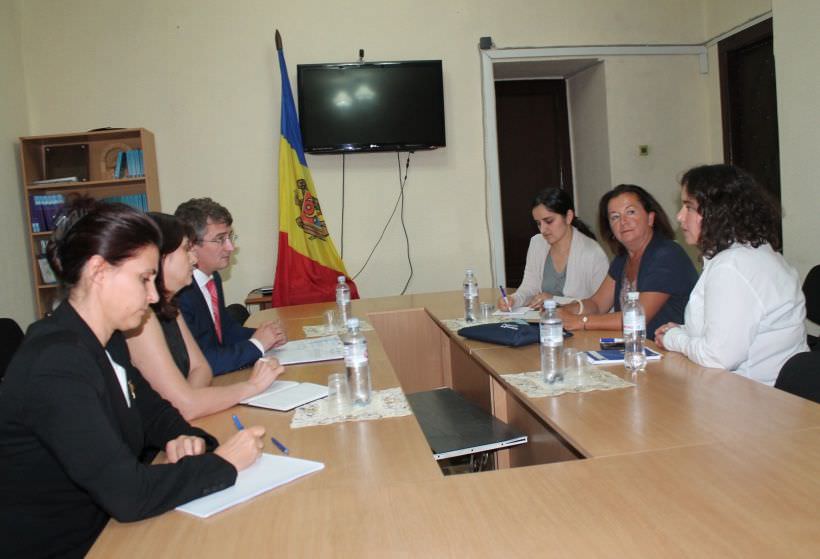
The situation in the field of patients rights in the Republic of Moldova in the context of human rights observance was the topic on the meeting between CHRM Director Anatolie Munteanu with Patricia Sanchez Rico, Resident Twinning Advisor of Twinning Project "Strengthening the Moldovan transplant agency and legislative harmonization in the field of quality and safety of substances of human origin" and Beatrice Senewaud, representative of the French Agency of Biomedecine who activate in the same project in Chisinau
Presenting general information on the situation in the sphere of health services, CHRM Director highlighted several issues that are mentioned recent years in the annual reports in of the Institution of human rights protection, such as failure to obtain informed consent of patient condition; failure of professional ethics by doctors; disclosure by doctors of personal data on the diagnosis, prescribed treatment, without the consent of the patient; poor quality of health services; lack of legal framework on malpractice.The Ombudsman also found that the medical system is severely affected by corruption: about 93% of Moldovans offers in certain circumstances to doctors some informal payments, these amounts annually rising to over 2 billion USD.Even insured population recourse to such payments, declared last year during a meeting CNAM Director. Thence arises the public opinion on the doctors performance - medical services are expensive, often inaccessible or frequently of poor quality, medical institutions do not have the necessary equipment or it is outdated.
At the request of international experts, the Ombudsman referred to cases that are under CHRM sight concerning the failure of patients rights respect and content referrals to the Constitutional Court made by Ombudsman on the complaints of citizens regardingthe health system. Anatolie Munteanu also highlighted the activities made in the field of patients’ rights observance in psychiatric hospitals and psycho-neurological facilities, monitoring actions of these institutions. In this context, the Parliamentary advocate revealed that the problem of complaints reception from patients in psychiatric institutions was discussed with one of the Deputy Ministers of Health.
In another context, Anatolie Munteanu said that now there is no a viable and equitable mechanism for submission and examination of patients’ complaints within the healthcare system from Republic of Moldova. The Ombudsman also stated that in order to be reinstated in their rights, some patients turn to the Center for Human Rights, in recent times attesting an increase of appeals on this issue. In other order of view, Anatolie Munteanu was referring to problems related to pre-judiciary examination of cases linked to non-observance of patients’ rights and some medical errors.
That's because of doctors cartel solidarity. According to the Parliamentary Advocate, in our country it is very difficult to obtain objective medical expertise.
The Ombudsman noted in this context that this phenomenon is caused in part by the condition whereby only one institution of higher education in the country has the right to prepare medical professionals. The parliamentary advocate referral of the Constitutional Court on this issue not shed light on this problem because the Court left the Parliament to decide on this issue.
Regarding the topic directly linked to transplantology, Anatolie Munteanu revealed that CHRM has conducted monitoring in this segment, the field in question being in the Ombudsman's attention only in the context of legality verification of mentioned procedures. The Ombudsman also pointed out that there have been no found deviations in this regard. The CHRM Director also revealed that at the national institution for human rights protection were not registered complaints from patients who have benefited from transplantation services of tissues or organs and has not been notified concerning irregularities in this process.
The European experts have described as very consistent and useful the discussion with the CHRM Director, noting that the obtained information will be of great use in realization of the project "Strengthening the Moldovan transplant agency and legislative harmonization in the field of quality and safety of substances of human origin".