
Suggestions of the Ombudsperson taken into account by the members of the delegation of the European Committee for the Prevention of Torture (CPT)
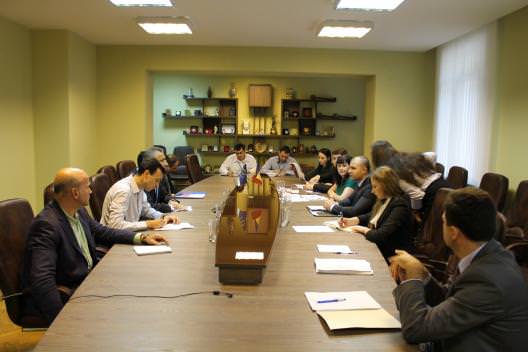
During 14-25 September 2015, a delegation of the European Committee for the Prevention of Torture (CPT) came on its 6th periodic visit to our country. On the first day of their visit, the experts met the Ombudsperson – Mihail Cotorobai, and the representatives of the Ombudsperson's Office, and learnt about the standpoint of the Ombudsperson's Office with regards to the situation in the penitentiary system and the observance of the European Convention for the Prevention of Torture.
Within a meeting that took place on 25 September 2015 at the Ministry of Justice, the members of the delegation of the European Committee for the Prevention of Torture (CPT) informed the decision-makers in the penitentiary system of Moldova about the preliminary conclusions of their visit in the Republic of Moldova. The meeting was attended by the Minister of Justice, the Head and representatives of the management of the Department of Penitentiary Institutions, as well as by employees of the Ombudsperson's Office – Gheorghe Bosii and Iurie Dubenco.
The CPT members mentioned in the submitted preliminary report that during their visit they learnt about the situation in the Penitentiaries No 6 from Soroca, No 1 from Rusca, No 10 from Goian, No 11 from Balti, No 13 from Chisinau, No 16 from Pruncu, No 17 from Rezina (the sector where persons convicted to life imprisonment are being detained). The aforementioned places were visited by also taking into account the suggestions of the Ombudsperson's Office, that carries out its activity in the field of prevention of and response to torture.
The key-issues to which the members of the CPT delegation wanted the authorities to pay attention to were ill-treatment of the detainees, violence among detainees, poor conditions of detention, poor medical assistance in penitentiaries. The observations of the experts of the Council of Europe matched the ones of the employees of Ombudsperson’s Office.
With regards to the ill-treatment of detainees, the members of CPT asked the competent authorities to conduct an independent and effective investigation of the complaints made by a few detainees in the Penitentiary No 10 from Goian. The juveniles in this penitentiary complained of having been subject to ill-treatments for two hours long by the employees of the penitentiary – they were pummeled, kicked and hand-cuffed.
The issue of violence among detainees was found in the Penitentiaries Nos 13, 17, 10, and particularly in the Penitentiary No 6 from Soroca, where the CPT experts concluded that the detainees are provided with conditions of detention depending on the informally established hierarchical status within the penitentiary. Also, some detainees are subject to violence and intimidation by other convicts. CPT drew the conclusion that the informal leaders of the detainees and the administration of the penitentiary have a silent agreement the purpose of which is for the former to keep order in the penitentiary. It was found that most of the detainees are being taken money from, which is used for the convenience of the convicts who have influence. This is happening because in the big dormitories the situation is not in the hands of the administration of the penitentiary, but in those of the influential convicts, and that is also because of the small number of employees of the penitentiary compared to that of detainees.
Given the silent agreement with the administration of the penitentiary, there is a clear difference between the conditions of detention provided to the inferior layers of detainees and the ones provided to the lead convicts. According to experts from Strasbourg, such a situation was not attested by CPT in any other member state of the Council of Europe. The CPT experts recommended the drafting of a strategy to eliminate the differences between conditions of detention provided to different categories of detainees, and to settle the issue of hierarchy between them.
This time again, the CPT members pointed out to the existing gaps in terms of poor conditions of detention. The overcrowdedness is still an issue in the Penitentiary No 13, where the detainees have to live in very crowded cells. The detention of 6 persons in a 8.6 m2 cell, the sanitary unit included – is unacceptable, the CPT members declared. They also specified that this is regarded as degrading treatment according to the European Convention against Torture. CPT asked the authorities of the Republic of Moldova to reduce the number of detainees in the Penitentiary No 13.
The members of CPT qualified the conditions of detention in the Penitentiary No 6 of Soroca as “horrible”, and recommended to immediately assess the situation in that penitentiary, and renovate the cells. By contrast, the Penitentiary No 7 from Rusca was given as an example, the conditions of detention being appropriate there.
The experts of the Council of Europe noticed the improvements since the last visit of CPT in Moldova in the year of 2011 in the Penitentiary No 17 from Rezina. The detainees serving life sentence are already provided with several facilities. They can communicate with the detainees from the same category, the hand-cuffing regime was simplified. Nevertheless, the life-term prisoners from the Penitentiary No 13 are still disadvantaged.
In the Penitentiary No 10 from Goian, the conditions in the detention cells were assessed as favourable, recommendations being made to repair the water closets in the penitentiary. It was also recommended to involve juveniles in week-end activities.
CPT members also found irregularities with regards to the regime of detention in sector No 12 of the Penitentiary No 6 from Soroca, where the detainees isolated themselves from the other convicts for reasons of safety.
Issues related to the quality of medical assistance in penitentiaries were found in the Penitentiary No 16 that has the status of penitentiary hospital, and in the medical sectors from the other penitentiaries. It was found that patients’ right to confidentiality was not observed, as the medical examination is being carried out in the presence of the staff. Some of the orderlies are selected from among the detainees, who are, thus, provided, free access to the medical records of the detainees. Also, the two examination rooms are separated by metal doors, there being no contact between the patient and the doctor. The CPT believes this practice is degrading. The conditions of detention in the Penitentiary No 16 are degrading in some wards as the necessary furniture is missing, and it was found that in the neurology ward the medicinal drugs are being procured by the detainees.